
Eyevinn’s Open Intercom is revolutionizing broadcast communication by replacing expensive, inflexible hardware systems with a lightweight, browser-based solution. Sweden’s public broadcaster SVT has demonstrated how this open-source technology can handle everything from complex daily productions to spontaneous field deployments — all while reducing costs and technical complexity. By enabling teams to communicate through any computer or smartphone, Open Intercom meets the growing demand for distributed, flexible production workflows without sacrificing quality or reliability.
Traditional intercom systems have long been a cornerstone of live production — but they come with high costs, inflexible setups, and heavy hardware dependencies. That’s why we built Open Intercom: a lightweight, open-source, browser-based intercom solution that gives broadcasters full control over their communications — without locking them into proprietary systems.
One of the broadcasters leading the way with Open Intercom is SVT, Sweden’s public service television company. Their experiences show how Open Intercom can be used not only to replace traditional systems, but also to expand what’s possible in modern, distributed production environments.
Lightweight Setup, Heavyweight Impact
Open Intercom is designed to run entirely in a browser — on any computer or smartphone — with minimal setup. For broadcasters like SVT, this has meant a dramatic reduction in time and equipment required to get productions up and running.
For example, entire events — rallies, niche sports, and even multi-day productions — have been managed using only laptops and headsets. Field reporters, commentators, and support staff simply connect to the Open Intercom backend, which SVT hosts in a containerized environment alongside their audio bridge.
No matrix, no proprietary panels — just browser tabs and clear audio.
Rethinking the Role of Traditional Systems
While traditional intercom systems still have their place, SVT has found that they’re often overkill for the majority of today’s productions. As a technical producer at SVT puts it, “Only about 5% of our productions really require the complexity of traditional intercom hardware. The other 95% could easily be done with something far simpler.” By using Open Intercom for the vast majority of lightweight or remote setups, SVT avoids the high costs and rigid workflows tied to systems designed for much larger productions. It’s a shift in mindset — from one-size-fits-all infrastructure to modular, right-sized tools that scale with the actual needs of a production.
Works on Its Own, or Alongside Legacy Systems
While Open Intercom is fully capable as a standalone intercom, it also plays well with existing infrastructure. SVT uses a custom bridge with virtual audio cards to integrate the Open Intercom with their legacy intercom-system, allowing for hybrid workflows without complex workarounds. They simply setup a session where the Open Intercom have both speaker and microphone on while the virtual audio card is connected to the legacy-intercom.
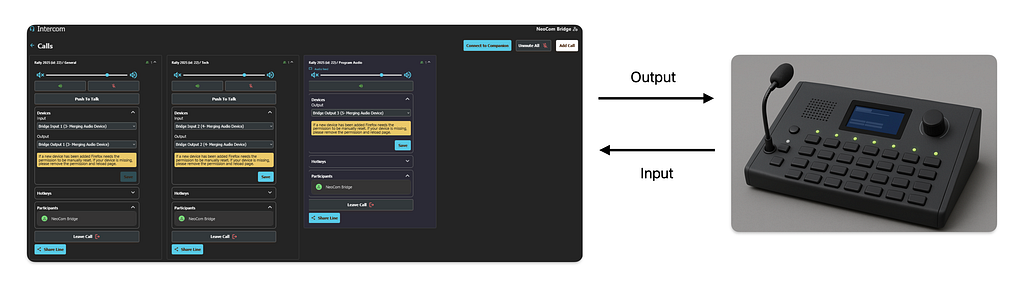
Whether routing mix-minus feeds to commentators or enabling reporters to monitor live program audio, Open Intercom can bridge digital and analog environments without friction.
From Ad-Hoc Spotting to Full Remote Productions
SVT has used Open Intercom in creative ways that reflect its flexibility:
- Remote spotting at ski events, where volunteers without any broadcast background report positions via Open Intercom from their phones.
- Self-produced live sports, where a single editor runs the entire production — from switching video to clipping highlights — while coordinating with commentators, all within a web browser.
- Quick setup of field comms, allowing editorial teams to rapidly deploy intercom lines to cover unexpected news events or sports moments.
The takeaway: whether you need a robust daily setup or a spontaneous field deployment, Open Intercom fits.
Designed for Scalability — Not Complexity
Unlike traditional systems where each new button or device adds complexity, Open Intercom scales through simplicity. Users only join the lines they need, and production leads can easily spin up isolated groups (e.g. “Camera Ops,” “Sound,” or “Program Feed”) with just a few clicks.
For production teams, this means less time managing the tool — and more time focusing on the actual production.
Built for the Way You Work Today
With the rise of remote production, Open Intercom aligns with how modern teams want to work: distributed, flexible, and efficient. SVT’s setup demonstrates how you can integrate browser-based intercom into your workflows without compromising audio quality or reliability.
And because it’s open-source, Open Intercom can be tailored to your needs — hosted on your own infrastructure, extended with custom features, or integrated with your control UIs and production logic.
Whether you’re looking to augment your current system or replace it entirely, Open Intercom is built for broadcasters who value flexibility, quality, and control — without the cost or constraints of traditional intercom hardware.
Interested in trying Open Intercom in your setup? Explore the code, read the docs, or get in touch with us at sales@eyevinn.se for support and custom integration options.