

A new development paradigm is emerging at the intersection of AI-assisted coding and open source cloud infrastructure. Vibe coding, a style where developers use AI and let tools like ChatGPT or Claude generate much of the code, is rapidly becoming mainstream.
At the same time, Eyevinn Open Source Cloud (OSC) are turning hundreds of open source projects into ready-to-use cloud services, free of vendor lock-in. Together, vibe coding and open source cloud services form a winning combination for developers and startups, enabling unprecedented speed and flexibility in building applications. In this article, we’ll explore what vibe coding is, why infrastructure is the missing piece, and how Open Source Cloud fills that gap to empower creators.
The Rise of Vibe Coding (AI-Powered Development)
Vibe coding refers to a development approach where AI takes the lead on writing code, and the human developer guides or fine-tunes the process. Instead of manually writing every line, programmers collaborate with AI coding assistants to generate functions, modules, and even entire apps almost effortlessly. In fact, a majority of the code in new startups is AI-generated, even when founders had strong coding skills. This “fast and fluid” approach is becoming the new norm because it dramatically accelerates development cycles without sacrificing quality.
Popular AI coding tools make vibe coding accessible to everyone. LLM-based copilots like ChatGPT, GitHub Copilot, and Claude Code can interpret natural language prompts and produce working code in various programming languages. More advanced agent-driven tools such as Cursor or Windsurf go further, they break down high-level tasks into subtasks, write code for each part, and integrate the pieces, all from a single prompt. With these tools, a solo developer can describe an idea (e.g. “build a web app for X with a database and user login”) and watch an AI agent scaffold much of the application automatically.
However, vibe coding alone doesn’t completely eliminate the work. While an AI can crank out your software logic, turning that code into a live, usable product requires infrastructure. This is where many startups still hit a bottleneck, you need to set up databases, storage, and hosting environments to run the AI-generated application. In short, even if coding feels magically easy now, someone still has to handle the cloud.
The Missing Piece: Infrastructure & Deployment Challenges
Imagine a small startup that just used an AI assistant to build a prototype web application. The app’s code might be ready in record time, but the team now faces the classic question: “Where do we deploy this, and how do we hook up the needed database and storage?”
Traditionally, there are two options, both with downsides:
- Self-Hosting or DIY Infrastructure: Setting up your own servers or local environment for the database, file storage, and application runtime. This often involves installing databases (like PostgreSQL or MongoDB), configuring web servers or containers, and managing hardware or VM instances. It’s doable for seasoned developers but time-consuming and not scalable. Every hour spent wrestling with Docker, Nginx, or database config is an hour not spent improving your app’s features.
- Proprietary Cloud Services: Using a big cloud provider (AWS, Azure, GCP, etc.) to host your app and data. While these offer convenience, they come with cost and lock-in concerns. Managed services like AWS RDS or S3 can become expensive for a bootstrapped startup, and relying on proprietary platforms can trap you in a single ecosystem. Migrating away later is painful, and you might be forced to adapt to that provider’s quirks and pricing. In short, you trade flexibility for convenience.
What’s clear is that infrastructure setup remains a hurdle for quickly sharing or launching the AI-built application. As one engineer put it, having a web app running locally is one thing, but making it accessible to users or stakeholders “requires a lot of infrastructure, time and effort you don’t want to spend just to show something that is work in progress”. This gap between code running on your laptop and a live service on the internet is where many projects stumble.
Open Source Cloud: Infrastructure at your fingertips
Open Source Cloud (OSC) addresses this very problem by providing a buffet of managed infrastructure built entirely on open-source tools. The idea is simple: take proven open source software (databases, storage systems, streaming engines, etc.) and offer them as on-demand cloud services, similar to AWS offerings, but without proprietary tech or walled gardens. OSC turns powerful open source tools into accessible Open Web Services with MCP support, unlocking 500+ tools that AI agents can use to build real solutions and applications for you”.
In practice, this means as a developer you can spin up components like databases or file storage as simple as vibe coding, knowing they are open source under the hood.
OSC solves the infrastructure challenge for startups by making powerful open-source software easily accessible as cloud services. Instead of manually setting up databases, storage systems, or web environments, developers can instantly deploy tools like PostgreSQL, MariaDB, or MinIO storage.
Because OSC exclusively uses open-source software, you maintain complete flexibility. If your needs change or you decide to self-host later, you can easily migrate your infrastructure without rewriting code. Plus, OSC unique revenue-sharing model supports the open-source community, meaning every time you deploy a service, you’re contributing directly to the creators of the tools you use.
In short, OSC provides the convenience and ease of managed cloud services while ensuring the freedom, transparency, and affordability of open source — perfectly complementing AI-assisted coding to streamline your path from idea to production.
Combining Vibe Coding with Open Source Cloud
The real magic happens when you use AI coding agents in tandem with Open Source Cloud’s capabilities. OSC was built with an “AI agent-first” philosophy, meaning it’s designed to be easily controlled by AI assistants (not just human clicks). This is enabled by Anthropic’s Model Context Protocol (MCP) integration. MCP is essentially a standardized way for AI models to interact with external tools and services through natural language instructions. In the context of OSC, MCP allows an AI agent (like an LLM Cursor or Claude) to directly call the OSC API and manage cloud services on your behalf.
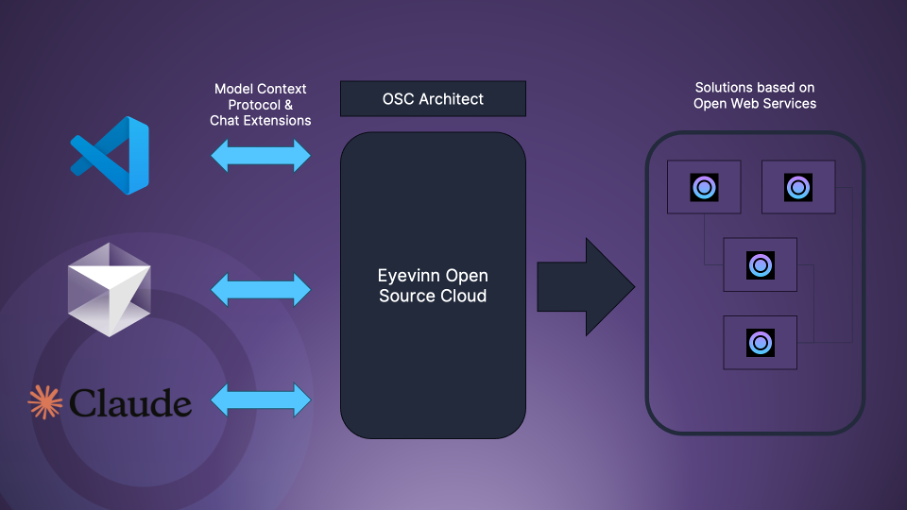
Consider how this works in a startup scenario: you describe your goal to an AI agent, for example, “Set up a new web application with a user database, an API server, and file storage for images”. With vibe coding, the AI can generate the application’s code (the web frontend, backend API, etc.). Thanks to OSC’s MCP support, the same AI agent can concurrently take care of the infrastructure: it will create a PostgreSQL database service for user data, allocate a MinIO storage bucket for images, and deploy the web app using Web Runner, all by communicating with the Open Source Cloud platform in the background.
The result is a fully working application stack assembled end-to-end by the AI, from code to cloud. You simply describe your needs in plain language and “AI agents will automatically deploy services, configure dashboards, and set up data pipelines, all without requiring deep technical knowledge.
The combination of vibe coding and open source cloud services essentially turns natural language into full-stack solutions. It’s a game-changer for productivity. A process that once took a team of specialists and weeks of effort, writing code, provisioning servers, configuring integrations, can now potentially be done in a single afternoon by one person and an AI helper.
For developers and founders, this means you can focus more on product vision and user experience, while the AI + open source cloud combo handles the boilerplate setup and infrastructure logic.
Conclusion: A New Era of Effortless Innovation
The combination of vibe coding and open source cloud infrastructure represents a fundamental shift in how software is built and launched. We are entering an era where building an application is as simple as describing what you need, and both the code and the cloud resources materialize almost automatically.
For developers and startup founders, this is a massive opportunity: it lowers barriers, speeds up innovation, and lets even small teams compete with the agility of much larger organizations.
Open Source Cloud, with its library of open web services and AI-friendly design, is a prime example of this transformation. It augments the power of AI coding tools by providing the missing puzzle piece, the environment where that AI-written code runs.
The result is a seamless pipeline from idea to implementation: you “vibe” with your AI to craft the software, and the open source cloud ensures it’s instantly available to users, no cloud lock-in strings attached.
For developers and startups, now is the time to embrace this game-changing combo. You can prototype boldly, iterate faster, and deploy confidently, knowing that the code you write (or that AI writes for you) is backed by flexible, transparent infrastructure. In practical terms, this means more time building the unique value of your product and less time wrestling with servers and services.
The future of app development is here, and it’s powered by AI and open source, working hand in hand.
Sign up for an Eyevinn Open Source Cloud account (for free) and enable OSC in your AI agent to get started.